“It’s just not right.”
Anger boiling up, feeling the need for release.
A quick intake of breath followed by a shocked stare.
All reaction to injustice, unfairness, or – if we take a more harsh approach – evil. We all have a desire for justice inside us. Think you don’t? When someone speeds around you in traffic, do you blissfully let it go or does a small part of you celebrate when they get stopped at the same red light as you? When the classmate who never studies while you study your butt off finally gets a worse grade than you, do you silently cheer? Or even more dramatic, do you not look at the oppression and exploitation of children and rejoice when their abusers are punished?
Justice – whether for wrongs against ourselves or others – is a very present human desire. Where does it come from? Well, it comes from the One whom we are imaged after, God.
Touch on Sin/Evil
The definition of justice is conformity to truth, fact, or the law. It can also be defined as righteousness or correctness – a definition I think we can all agree on. However, it is missing a few key points: who’s truth, fact, or law are we talking about?
This takes us back to the creation of the world. The One who made the universe knows best how it should run. Justice then is based on what – or Who – you believe the universe is run on. We see in the Bible, God created the first humans – Adam and Eve (Genesis 1:1; 2:7, 21-22). He then proceeds to instruct them how to live (Genesis 2:16-17 ) – the first laws. which they immediately break (Genesis 3:1-6 ). As we go throughout the Bible, we see more laws. These get complicated and confusing, and unfortunately, the pattern of receiving and breaking God’s laws doesn’t end with Adam and Eve. But when Jesus arrives, we see Him describe the law in a radical way. He summarizes the whole of His law like this: “‘Love the Lord your God with all your heart and with all your soul and with all your mind.’ This is the first and greatest commandment. And the second is like it: ‘Love your neighbor as yourself.’ All the Law and the Prophets hang on these two commandments.” (Matthew 22:37-40 ).”
We derive from this then that injustice is the failure to love God (namely the failure to be satisfied in, completely trust, and fully obey God) and the failure to love others (the antithesis of everything it says in 1 Corinthians 13).
Simple, right? Well, actually this is where it gets tricky. We are quick to point out injustice – or evil – when we see it in others. Abuse, oppression, neglect all are easily spotted in the big acts of evil, such as murder or racism. But what about what we see in Romans 3:10?
“None is righteous, no not one…”
Uh oh. Umm that includes us. The tricky part about evil is not that it’s in some individuals. It’s that it runs through each of us.
The same selfish heart that steals consent from another is the same selfish heart I display when I cut off someone in traffic. The same self-centered heart that neglects the needy in their care is the same self-centered heart I display when I ignore the awkward girl in the corner of the party. The same wrathful, vengeful heart that drives one to murder is the same wrathful, vengeful heart I display when I vent my anger against those who annoy me.
Different displays, same evil.
That’s a big statement, isn’t it? What I’ve just compared us to is what we consider the most devastating kinds of evil.
You may ask, if we are all subject to receive and dole out evil, what’s the point? Well, this by no means is permission to do whatever because “you’ve already practically done it anyway.” But it’s a call to see that we have the same evil in our hearts.
So, what’s God going to do about it?
Justice of God
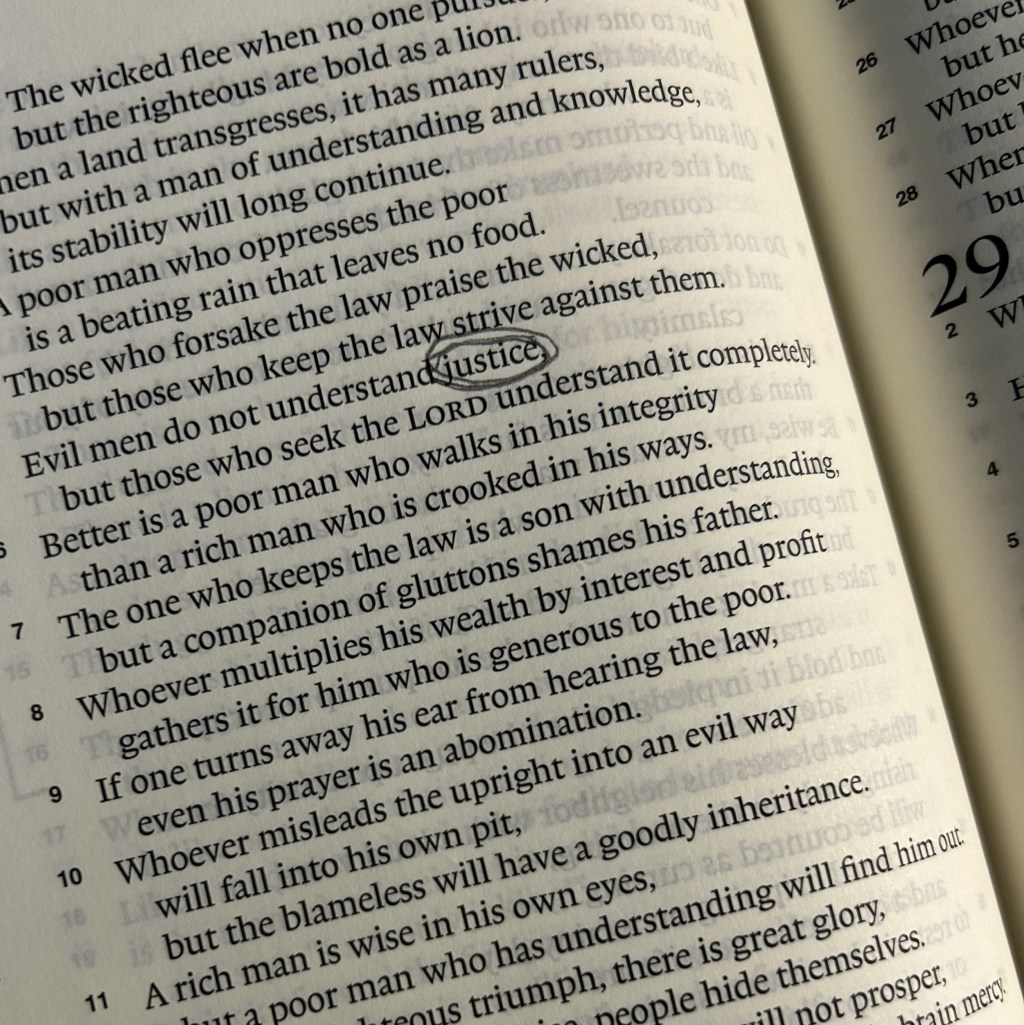
Evil men do not understand justice,
but those who seek the LORD understand it completely.
(Proverbs 28:5)
With God’s justice, I usually see two directions. One is the bemoaning of it as too wrathful or too harsh. Why is God so hateful? What we are doing is harmless! The second direction is frustration with God for not punishing evil. He takes too long! Where is He when all this evil is happening around us? And this is not a new phenomenon. In the Psalms we see the psalmists go back and forth between asking God for more mercy (Psalm 4:1, Psalm 22:1-2, 11; Psalm 71:12 ) and begging for Him to do justice (Psalm 35:1-2; Psalm 58, Psalm 94:1-2).
The reason we see this back and forth between mercy (or love) and justice is because they are deeply connected. God sees the deathly consequences of evil. It harms, destroys, and kills – even the “minor evils” can bring about severe consequences. The reality is all injustice (or the failure to love God and His people) leads to death (Proverbs 22:8 ). The most loving thing to do when someone is in danger of death is to bring them into life. This is exactly what God seeks to do with His justice.
But why then does He sometimes seem slow in this justice? In Tim Keller’s book The Prodigal Prophet, he discusses how Jonah in his anger at God’s lack of “justice” against the Ninevites uses God’s words – AKA the Bible – to berate Him. Tim says, “He reads the Bible selectively, ignoring the latter part of Exodus 34:7 that speaks of God not leaving ‘the guilty unpunished.’ He creates a simplistic picture of a God… [using] the sacred text to justify his inordinate indignation, anger, and bitterness” (105). Tim goes on to explain how we can do the same thing. He says that we are “reading and using the Bible rightly only when it humbles us, critiques us, and encourages us with God’s love and grace despite our flaws” (106).
What’s my point? Knowing God – which we can do, namely through spending time in His Word – gives us a complete understanding of justice because it teaches us to humbly trust that when we lay vengeance down, God picks it up for us (Romans 12:19). Seeking Jesus teaches us that we are so undeserving of mercy. So how could we berate others for receiving the same gift, even if just temporarily?
And we can know this – that He is trustworthy to avenge and gives to us undeservingly fully in that He sent His own Son to satisfy justice (1 Thessalonians 1:10, 5:9). Jesus completely atoned for the wages of injustice – or sin. He did not leave us to face the correction of the law on our own. If He is faithful to satisfy the just consequences of our shortcomings, He will be faithful to execute and satisfy justice in the future.
“Behold my servant, whom I uphold,
my chosen, in whom my soul delights;
I have put my Spirit upon Him’
He will bring forth justice to the nations…
a bruised reed He will not break,
and a faintly burning wick He will not quench;
He will not grow faint or be discouraged
till He has established justice in the earth
and the coastlands wait for His law.
(Isaiah 42:1, 3-4)
Resources
- Only Christians Understand True Social Justice by Bryce Young
- What Does It Mean That God is a God of Justice by GotQuestions
- Evil and the Justice of God by N.T Wright

 Overwhelmed