The love of God feels like a hot button topic. It’s tricky because we use this word a lot. Unlike holiness, we talk about love all the time. We love TV shows, food, people, movies, clothes, restaurants, and ice cream.
And we talk about God’s love frequently too, to the point it may seem overemphasized. However, this is not the case. God’s love is vital to understand because as John Owen noted, “every discovery of God without [seeing him as loving] will but make the soul fly from him.” And as Charles Spurgeon put it, “When the love of God is shed abroad in the heart, the idols will soon depart and the love of sin will take its flight.” Why is this the case? Because if God’s holiness and sovereignty was against us rather than for us we would rush from Him into the arms of other objects for love.
Understanding the love of God then is not just essential to our understanding of His heart but also to setting our hearts in a pursuit of Him. . And the best way to understand God’s love is by laying aside our assumptions and looking at how He Himself has already revealed His love through Scripture.
The Smile of God
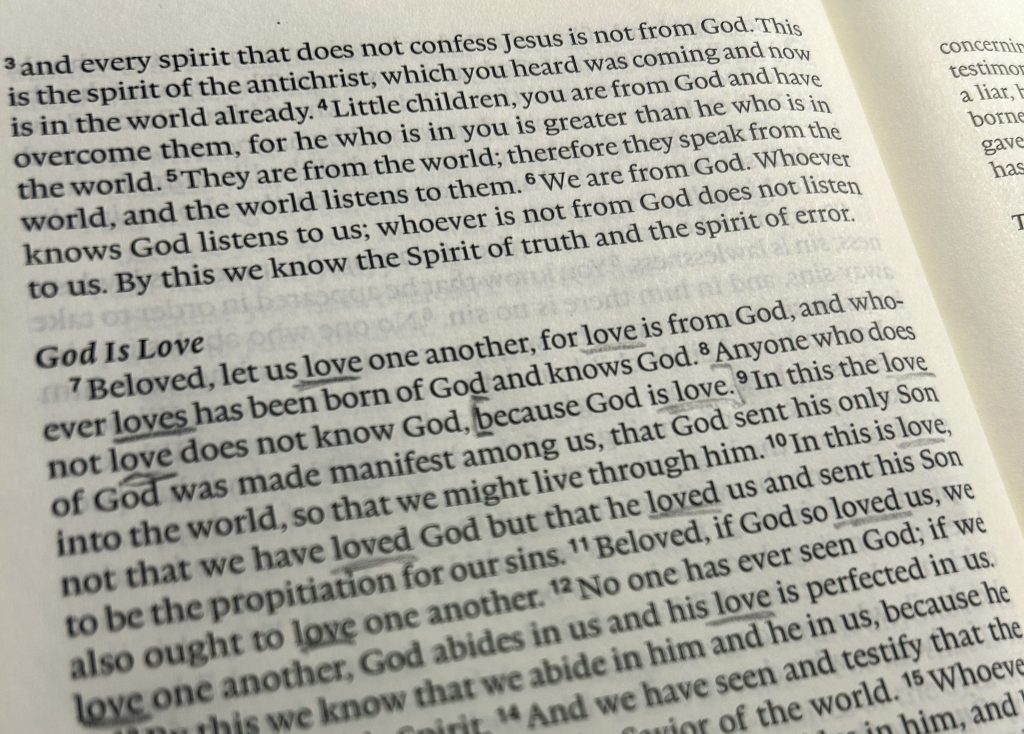
Beloved let us love one another for love is from God, and whoever loves has been born of God and knows God. Anyone who does not love does not know God, because God is love. In this the love of God was made manifest among us, that God sent His only Son into the world, so that we might live through Him. In this is love, not that we have loved God but that He loved us and sent His Son to be the propitiation for our sins.
(1 John 4:7-10)
What makes the Christian God distinct from the other “gods” is that He is in every part of His being love. God is love. Every love we experience is a shadow and echo of His love. But what does this love look like?
Above we see that God’s love is sacrificial (1 John 4:10), it initiates (1 John 4:9, Romans 5:8), and it purifies us (1 John 4:10). In fact, the Gospel – that Jesus came to live a life we could not live and died in our place to rescue us from death — is God’s ultimate display of love. Even when we were dead, broken, wicked, and ugly, God loved us and wanted to make us alive again (Ephesians 2:4-5). Because of this, He sent His only Son to forgive us from our crimes against Him (John 3:16-17).
Stop here for a moment. Do you believe this? Do you believe that it was His love that motivated Him to rescue us and that this same love still reaches out to you? Do you believe that because His love is faithful and pure He will never leave you nor forsake you?
If you are reading this today and questioning whether God’s love really extends to you, I want to invite you to think about something…why would the King of Kings, the Lord Most High, go through all that suffering and turmoil of the cross to leave you behind? His heart is to chase down the one, to save the lost and the broken (Matthew 18:12-14; Luke 5:31-32). He died for you, knowing all about your sin because He loves you.
All of this reflection on God’s love can often bring up another fear: God may love me, but He doesn’t like me. To this I say, read Zephaniah 3:17 and Isaiah 62:4.
The Lord your God is in your
midst,
a mighty one who will save;
He will rejoice over you with
gladness;
He will quiet you by His love;
He will exult over you with loud
singing.
(Zepheniah 3:17)
You shall no more be termed
Forsaken,
and your land shall no more be
termed Desolate,
but you shall be called My Delight Is in Her,
and your land Married;
for the Lord delights in you…
(Isaiah 62:4)
He delights in us. He rejoices over us with singing. Does that sound like God dislikes us? Does that sound like a love shown out of pure duty? As author C.S. Lewis says, “To please God . . . to be a real ingredient in the divine happiness . . . to be loved by God, not merely pitied, but delighted in as an artist delights in his work or a father in a son — it seems impossible, a weight or burden of glory which our thoughts can hardly sustain. But so it is” (The Weight of Glory).
If God did not “like” us would we be able to take refuge in His wings (Psalm 36:7)? Do not ignore the heart of Jesus (who is one with God) that expressed an earnest desire to gather His people under His wings like a mother hen gathers together and protects her chicks (Luke 13:34)! Read 1 Corinthians 13:4-8, the descriptor of love. Does that sound like a begrudging affection? He loves and so delights in us that He calls us friends and His children (John 15:15, 1 John 3:1). This is not a “loved but not liked” situation!
And we know that this love never leaves us (Romans 8:37-39). It is not a part time love and affection. God will forever and always love His children (Jeremiah 31:3). Just as He loved the disciples to the end, so He will love us (John 13:1). Everything He does is loving. Just like His goodness and holiness and the many other characteristics we will see, His actions flow from His love.
And yet. This love can often bring confusion.
The Confusion of Love
“I gave you cleanness of teeth in all
your cities,
and lack of bread in all your
places,
yet you did not return to me,”
declares the LORD.
(Amos 4:6)
Amos 4 is a confusing passage. It explains how God withheld rain from His people, struck them with blight and mildew, overthrew their nation, and sent pestilence upon them (Amos 4:6-12). You may wonder, if God truly is loving, how could He do this to His people? The age-old argument has been that the Old Testament God is just simply “mean” compared to the loving God of the New Testament. But the truth is God’s actions to Israel in the book of Amos are actually loving.
God’s love drives Him to do whatever it takes to rescue you, even if it brings harm. He knows the result of sin is death (Romans 6:23). His love does not want us swept away in the judgment of the world (1 Corinthians 11:30-32). As author Greg Morse says, “He will not leave us to perish. When we wander toward cliffs, he corrals us with his rod back toward heaven. What feels to be the glory of the “god of love” — being left to our own way — is, in reality, his wrath, which bears the refrain: ‘God gave them up . . . gave them up . . . gave them up’” (“Would a Loving God Wound Me?”). What Morse is saying is that each time individuals are allowed to “do as they please,” they lose closeness with the Father (Romans 1:24-28). The Father disciplines those He loves because He would rather them experience the fullness of joy in His presence than the temporary thrill of things that lead to death (Hebrews 12:5-6).
Not only does this involve discipline but also trials. In John 11:5-6, we see that Jesus loves Martha, Mary, and Lazarus. And because of this love, He wanted to see Lazarus when he was ill. But Jesus ended up waiting two days before He started on the journey towards Lazarus. Lazarus ended up dying before Jesus reached Him (John 11:13-14). It seems all wrong. How could love cause – no, allow – grief? The disciples are just as confused. Then, Jesus gives them and us an answer in verse 15: it happened so that they could believe. It is more vital that they receive eternal life and joy than it is to receive temporary comfort.
Yet, make no mistake – God does not delight to afflict or allow affliction (Lamentations 3:31-33). But He wants us close to Him, so much so that He bore affliction to draw us in. Jesus died to keep us from being far from the Father (Luke 12:32, Matthew 25:23, John 14:3). God took the ultimate harm and pain upon Himself to purchase the freedom for us to come back to Him.
This seems to make His love more personal and meaningful. It is not as if He is a celebrity who generally states He “loves” His fans. His love is a kind that not only knows what our need and fills usHe knows so deeply that His love knows personally what we need. He is not like a friend who loves but not enough to tell you when you’re wrong and keep you from making foolish decisions. He wants what’s best for you even if it means you hold anger against Him.
This love does not just forgive and keep you at a distance. It forgives, draws you close, and walks with you as you grow through grief and victory. The love of God is deeper than anything you can imagine – may we all contemplate it for our lifetimes and beyond.
Resources
- Delighting in the Trinity by Michael Reeves
- “Would a Loving God Wound Me?” by Greg Morse
- Gentle and Lowly by Dane Ortlund
- “The Mean Old Testament God” by Phylicia Masonheimer

 Overwhelmed