For a word we use a lot it seems we don’t know much about it.
“Holy” is an attribute we know God has, but often don’t fully comprehend. We see it throughout scripture. His name is so holy we are not to use it casually (Exodus 20:7). In fact, the Bible says His name is Holy and He dwells in a holy place too (Isaiah 57:15). There is no one holy like God (1 Samuel 2:2). We’re told to often remember and voice that God is holy (Matthew 6:9) and be holy just like Him (1 Peter 1:16-17).
But what is holiness? It sounds stiff and scary, maybe rather boring. Or maybe you know what it means briefly but have not spent enough time thinking over it to be amazed by it. It’s just something about God.
The reality is this though: this is a vital attribute of God to understand. There’s a reason I could not move past the second month without talking over this attribute. Because as author Jackie Hill Perry says in her book Holier Than Thou, “To say that God is holy is to say that God is God” (14). When the angels in Isaiah 6 cried out at the throne of the Lord, they emphasized nothing but God’s holiness (Isaiah 6:3). Holiness is not simply an aspect of God but who He is through and through. God is Holy.
So what does that mean?
Definition of God’s Holiness in Scriptures
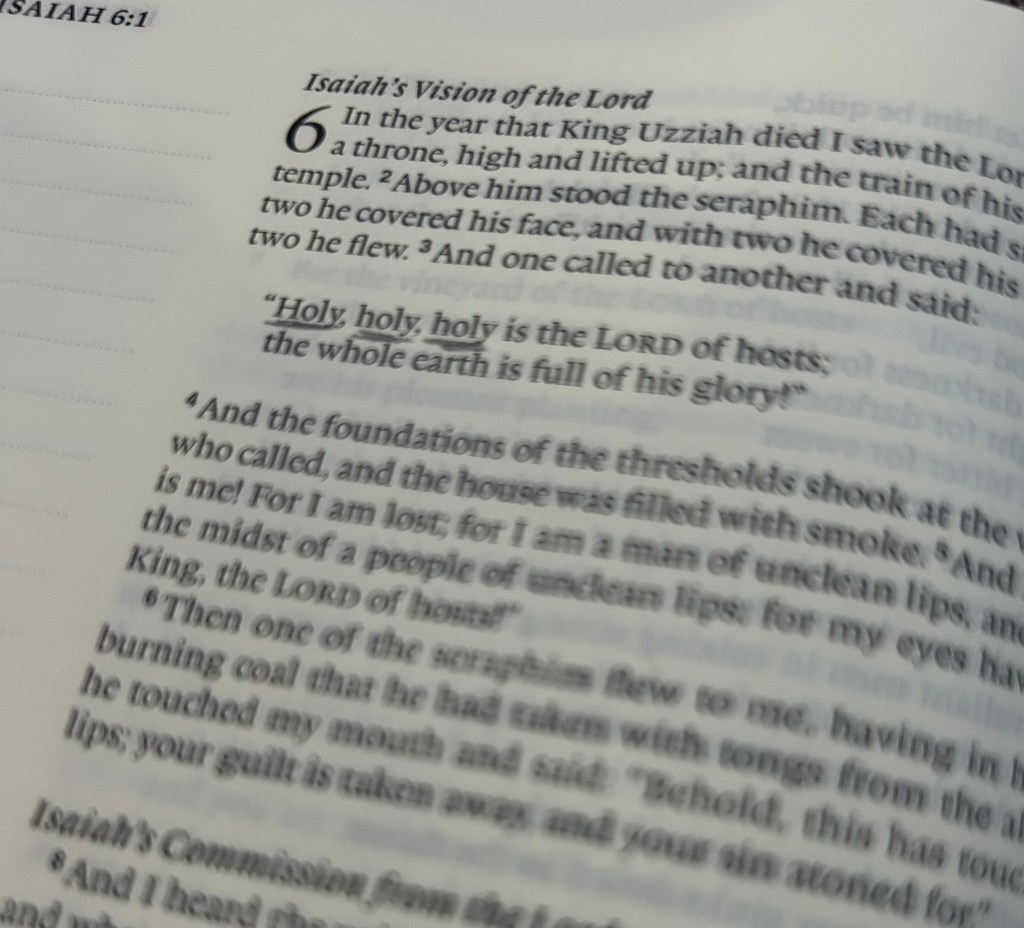
And one called to another and said:
“Holy, holy, holy is the LORD of
Hosts;
the whole earth is full of His
glory!”
(Isaiah 6:3)
I once read a definition of holy as “Unparalleled majesty of His incomparable being and HIs blameless, faultless, unblemished moral purity.” Cue the glaze over your eyes. Though an accurate definition, it might seem overwhelming and a little incomprehensible.
The word for holy is קָדוֹשׁ in the Old Testament and ἅγιος in the Greek. Both are defined as “separate or set apart.” To be holy is to be set apart. We even see this in the Bible when a sacrifice or object is dedicated to the Lord. That sacrifice or object becomes holy because it is set apart. God, then, is completely separate from anything we can imagine, namely He is utterly unique. A fancy theological word for this would be “transcendence.” He transcends all categories unless the category name is “God” (Holier Than Thou, 64). He isn’t simply better, but completely set apart.
Now, how this plays out has several different aspects. The first would be because God is so unique, He has no dependence on anything or anyone (Acts 17:24-25). He had no beginning. He does not need water or food or air. The life God has is self-sustained. The only reason for creation was for His pleasure. He has no need. No one can compare to Him in this or be His equal (Psalm 86:8, Isaiah 40:25).
Holiness or His set apartness also plays out in justice, which we will talk about in a later month. But the aspect of moral purity in holiness is vital to touch on. Because if God is completely holy and set apart, He cannot do evil. If He cannot do evil, He is completely trustworthy.
Why Holiness Makes Him Trustworthy
“If God is Holy, then He can’t sin.
If God can’t sin, then He can’t sin against you.
If He can’t sin against you, shouldn’t that make Him
the most trustworthy being there is?”
(Holier Than Thou)
We don’t often associate holiness with trustworthiness do we? In fact, the idea of being separate can make us feel cold and distant. How can someone so distant be trustworthy? John Piper highlights another aspect of holiness to address this. He explains that for anything to have value, it must be unique, permanent, and accessible. Gold is valuable because it is rare (unique) and does not rot or fade (permanent). But it’s also accessible. As John Piper says, “there are rocks… so far down way more rare than gold, but you can’t get at some and so they’re useless.” Value is also dependent on accessibility.
The separateness of holiness, then, does not mean absent or unavailable. God makes Himself readily available (Romans 5:6-8). The reason He is uniquely separate is because His love is nothing like ours. All the harmful actions against an individual – murder, abuse, theft – are simply not present in God. He does not lie (Numbers 23:19, Titus 1:2). It is an abomination to Him to withhold justice (Proverbs 17:15). He is not apathetic but reaches out first and carries our loads (1 Peter 5:7). He draws near to the broken and rejected not passively or to “have a good time” but to heal and confront with precision and grace (Mark 2:15, Luke 7:37-48). He is not selfish. He does not abuse others for gain (Acts 17:24-25). The most wonderful display of love and trustworthiness cannot compare to God (Isaiah 40:25).
Who God is then is so radically different from everything we are and everything we’ve encountered. His justice, wisdom, goodness, knowledge, presence, sovereignty, grace, mercy, kindness, love, and every other characteristic are perfect. He, then – as Jackie Hill Perry said above – is the most worthy of our trust. It is who He is: Holy.

 Overwhelmed