“What comes into our minds when we think about God is the most important thing about us”
(A.W. Tozer)
You’ve probably heard this quote before. Maybe you’re like me and have heard this quote almost every time you open a book or online article. Or maybe this is your first time hearing it. Whatever is the case, it is a very true sentiment. Who we think God is says a lot about who we are.
My hope is that these articles in the coming year would shape those thoughts. When I was reflecting on what I wanted to lean into with God this year (AKA my word of the year), His character was integral. Each month, then, I want to highlight a different aspect of God’s character. The plan is to make it short enough to come back to as a reference, yet detailed enough to use as a learning or teaching tool. Hopefully it achieves just that!
And the characteristic I want to start with is goodness.
Definition of Goodness and Examples in Scripture
“Goodness” is a hard word to define. When I looked it up in the dictionary, there were several slightly varying answers. It could be described as “nutritious or flavorful,” a “beneficial part,” “of high or desired quality,” “suitable,” “profitable,” “pleasant,” “virtuous,” “kind,” “moral,” or “ethical.” It could be used in relation to food, a party, a person, a car, or even weather. When thinking about God’s goodness, then, it can be even trickier to define.
What complicates the matter more is the variations of contexts in which goodness is used to describe God. As the author Andrew Wilson says, it can be used as a property, definition, or experience of God. A property would be using “goodness” to describe God. For example, you might think pineapple is good. But a definition would be the summary of who God is. So while pineapple might be good to you, it would be incomplete to use that as its definition. “Good” could be used in the definition, but it doesn’t complete it. But for God, “goodness” can be used as a full definition of who He is.
We see in Exodus 33:19 when Moses asks God to reveal who He is to him, God tells him that He “will make all [His] goodness pass before” Moses. God is good. He is every good thing and more. And we see this throughout the Bible.
God’s works are good (Psalm 119:68). His deepest desire was to cleanse a begging leper (Matthew 8:2-3). Look around at creation! He gives incredibly beautiful and good gifts (James 1:17, Matthew 7:11). People will share the story of His goodness and compassion on all creation (Psalm 145:7-9). In fact, compassion is a repeated adjective for Jesus (Matthew 14:14, Mark 6:34, Matthew 15:32, Luke 7:13, etc.). Those who trust in Him lack no good thing (Psalm 34:10). No one is truly good beside Him (Mark 10:18). God works for the good of His children (Romans 8:28). His goodness chases us down (Psalm 23:6), drawing Himself to the broken, outcast, and undeserving (Luke 7:34).
But goodness is not just a property or definition of God, it is also an experience of Him.
Goodness in Hard Seasons
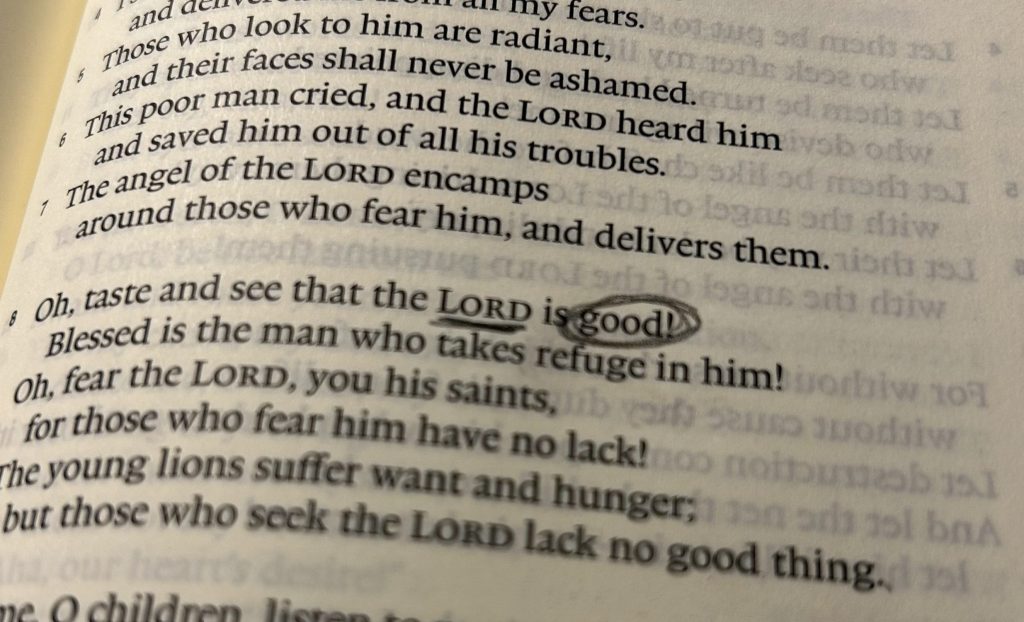
Taste and see that the Lord is good…
(Psalm 34:8)
Taste is a subjective thing. Unlike a definition or property, experience is subjective. And we read here that even the experience, a subjective idea like taste, of God is good.
But what if you feel like it isn’t? What if you are going through the hardest season of your life? Yes, maybe you still believe God is good by definition and property but definitely not by experience. And that was the exact experience I struggled with, which might be incredibly obvious by every article I write. I knew God was good but certainly didn’t experience Him that way sometimes.
But this is where the definition of “goodness” comes in handy again. When looking at the definition a solid summary seems to be that “goodness” means “satisfying.” A good meal satisfies our hunger, a good person satisfies our need for love and care, and good weather satisfies our need for comfort. And God is infinitely satisfying.
God’s goodness is completely satisfying, the supreme fulfillment of good (Psalm 103:5, Psalm 65:4). He fills the hungry with good (Psalm 107:9). He says His people will feast and be fulfilled by His good (Jeremiah 31:14). So even when His good gifts seem absent and His good works don’t seem to come through, He is still completely, satisfyingly good.
This is the idea of Psalm 73. It is good to be near God, namely God is our good (Psalm 73:28). The truth of the gospel is that we don’t come to just a property or definition or doctrine, we come to experience a person (John 6:37). And this is vital. Because as Dane Ortlund said, “Seeing God’s greatness [AKA the good gifts and works He provides] is not our deepest need, but seeing His goodness” (97).
As we move to speak of other attributes of God, we must remember that they are in relation to one another. God’s goodness actually cannot be seen correctly without His justice, or His justice without His mercy, or His mercy without His power. As John Piper said, “The glory of God is not found in dissecting His perfections into separate parts, but in seeing them whole and keeping them in connection with each other.” So as we continue to study who God is throughout the year, recall each part in relation to another. God is good because He is just, merciful, all-powerful, loving, wise, and forgiving. The nature of His heart is overwhelming.. So let us be overwhelmed by Him.
Resources
- Look up the verse references about God’s goodness. Choose one that stands out the most, write it on a notecard or post-it, and put it somewhere you will see it
- What areas of life do you have trouble experiencing God’s goodness?
- Gentle and Lowly by Dane Ortlund
- Goodness and Me by Andrew Wilson
- Will God Hurt Me and Call It Good? by John Piper

 Overwhelmed