“You’re not broken. You’re perfect.”
I had never heard more harmful words.
I failed pretty hard this year. I got snippy with others, I’ve yelled at other drivers more than I am willing to admit, I packed my schedule and left little room for God, I wasn’t always the best role model, I complained, I took the easier route on things, I treated loved ones poorly, I ran from problems, I chose selfishness, I fell into temptation, I felt depressed to the point of despair, and worst of all, I felt like I was completely helpless in these situations. That’s what made statements like the one I heard above from a podcast so hurtful.
This year my brokenness was on full display. And isn’t it funny that that’s the word I felt the Lord was placing on my heart for the year?
I remember the word popping up in late fall of 2024. Psalm 51 had come up in church and really stuck out to me. I had begun noticing sin patterns in my life and was sure that was what the Lord wanted to work on me in the following year. I was thinking fight or victory might be the word, though. You know, words that are pretty positive. But then broken came playing in my head. Really? That feels a little odd.
“You know Caitlyn, I feel like broken will actually bring a lot of rest for you,” my friend said to me when I told her about that word. I was upset because I had just ended a year of surrender; I was tired. How on earth could this be more restful?
In fact, what it felt like was an even heavier burden.
A Right Sacrifice
Psalm 51 was written by David after he made a very big mistake. He saw a lady bathing on her roof and decided he liked what he saw enough to sleep with her (2 Samuel 11:2-4). Not only was she married but now she was pregnant (2 Samuel 11:5) and her husband was out at war. Yikes. To handle the mess, David requested that her husband be put on the front line so that he would have a greater risk of dying, which he did (2 Samuel 11:14-24). Like I said, very big mistake.
This is when Nathan, a prophet of God (people through whom God would speak during these ancient times) steps in. David gets rebuked by Nathan and immediately recognizes the great wrongs of his actions. I mean an affair and a murder to cover it up? Talk about a soap opera. Psalm 51 is David’s cry to God for forgiveness and his repentance of his failures. The particular part of Psalm 51 that stuck out to me were verses 16-17:
For you will not delight in sacrifice, or I would give it;
You will not be pleased with a burnt offering.
The sacrifices of God are a broken spirit;
a broken and contrite heart, O God, you will not despise.
Because wait… does God want us to be broken?? It says He won’t delight in other sacrifices. The sacrifices of the Lord are a broken heart and spirit. And we’re called to present ourselves as sacrifices to God (Romans 12:1). So God wants us to be broken so we can be a proper sacrifice? You’re reading that too, right?
And if you read this verse in the complete context, David is actually praising God for this (Psalm 51:15). It sounded just like when my friend said “brokenness” could be restful. How could this be a good thing? And why would God want us broken?
Already Broken
And then the rest of the year came.
It started off pretty strong in me realizing how many times I fall short. Anxiety showed up in the form of anger and irritability. My fuse grew shorter and tears grew in number. I realized that my expectations of myself were so great that while everyone else might be broken, I am simply just bad. Sure, I believed God would give me strength when my weaknesses showed up, but certainly not when I made a mistake. I would have to deal with those consequences. Such beliefs led to seeking the help of a therapist, who pointed me back to God and His truth. I needed help seeing the truth because I wasn’t able to see it on my own. My sight was broken. I was broken.
Later in the year, as I finished up nursing school, I worked at a summer camp and in the emergency department of one of the largest – if not the largest – hospitals in my area. Both were heavy. I saw kids who were given months worth of extra insulin because their guardians refused to drive them to get more back home. I saw people come in who wanted to be dead. I saw people who had drunk themselves to the brink of death. I saw freak accidents that tore loved ones away from family too soon. I saw drugs take control of people who felt like there was no way out. I saw children encounter pain that they should never know at their age. I saw the elderly left alone in rooms with no one to comfort except the medical staff. I simply cannot use enough words to explain the tragedy and pain witnessed. And that was just during my clinical experiences.
In my personal circles, I witnessed loss of relationships and experienced the loss of a pet. I saw disunity rear its ugly head, tearing at the bonds of friends. I saw the heaviness of school and work and life burden students to tears countless times. All while dealing with the same temptations to anger, frustration, and selfishness in myself. The world was broken.
What I realized this year was that God doesn’t want us broken — we already are broken. We live in a world in a state of brokenness. To ignore this leads to anxiousness and despair. That’s why I take such offense at “you’re not broken.” Because I lived in a way that didn’t fully comprehend I or the world was broken, and despair quickly set in. Thoughts that had stayed in the shadows suddenly sprang into the light. I knew the world and I weren’t perfect. I knew there were weaknesses. But what I had to realize, as I said in my April article “Take Your Weakness Seriously,” is that I was weak. I was broken. The world was broken. I could no longer ignore this reality.
Because He Lives
But we have this treasure in jars of clay, to show that the surpassing power belongs to God and not to us. We are afflicted in every way, but not crushed; perplexed, but not driven to despair; persecuted, but not forsaken; struck down, but not destroyed; always carrying in the body the death of Jesus, so that the life of Jesus may also be manifested in our bodies… So we do not lose heart. Though our outer self is wasting away, our inner self is being renewed day by day.
(2 Corinthians 4:7-10, 16)
I can honestly say I did not believe this verse. I felt crushed by affliction, driven to despair by the perplexing brokenness I saw around me, forsaken and alone, and destroyed by the heaviness. I don’t say this lightly: I felt life was not worth living. Suffering, pain, and death seemed to be around every corner. Even the good things were haunted by the thought of “this won’t last” or “this could end in an instant.” Life scared me. But now, for the first time, so did death. I began to fear dying like never before. What if it was painful? Would I feel it? How could I face eternity? I felt trapped.
I remember the day I told my mentor and a friend about these thoughts. I had determined it was time to talk about it. Both told me that talking to my therapist would be a good idea. But both conversations – though helpful – didn’t solve the issue. What it did do was keep the issue on my mind until that night when we had our weekly service for the campus ministry I work for. It was a worship night, meaning we spent the night singing worship songs and praying. A song came on that I had never heard before, but the lyrics stuck out:
Because He lives I can face tomorrow,
Because He lives all my fear is gone,
Because I know He holds the future,
Life is worth the living just because He lives
Immediate tears.
To me life was not worth living because of the brokenness it was characterized by. How can one live in a broken world and still face tomorrow? Well, I missed that part in 2 Corinthians:
…always carrying in the body the death of Jesus, so that the life of Jesus may also be manifested in our bodies…
(2 Corinthians 4:10)
We may experience the brokenness of the world just like Jesus did. But because He rose again – because He lives – we can face it. In Psalm 51, the assumption was never that God wants to “break people.” We are already broken and He simply wants us to come as we are. The sacrifice He wants is our acknowledgement that we are broken and need His help to make us whole. As John Piper said in an Advent devotional, “The only people whose soul can truly magnify the Lord are people like Elizabeth and Mary — people who acknowledge their lowly estate and are overwhelmed by the condescension of the magnificent God.” That’s the sacrifice God desires.
I wish I could say after realizing all this that my thoughts went away. They didn’t. In fact, just before I began writing this, I spiraled about the death of my loved ones. But here’s what keeps me going in the brokenness of myself and this world: Every fear may come true. Every worry of loved ones dying may become reality. Every nightmare might happen.
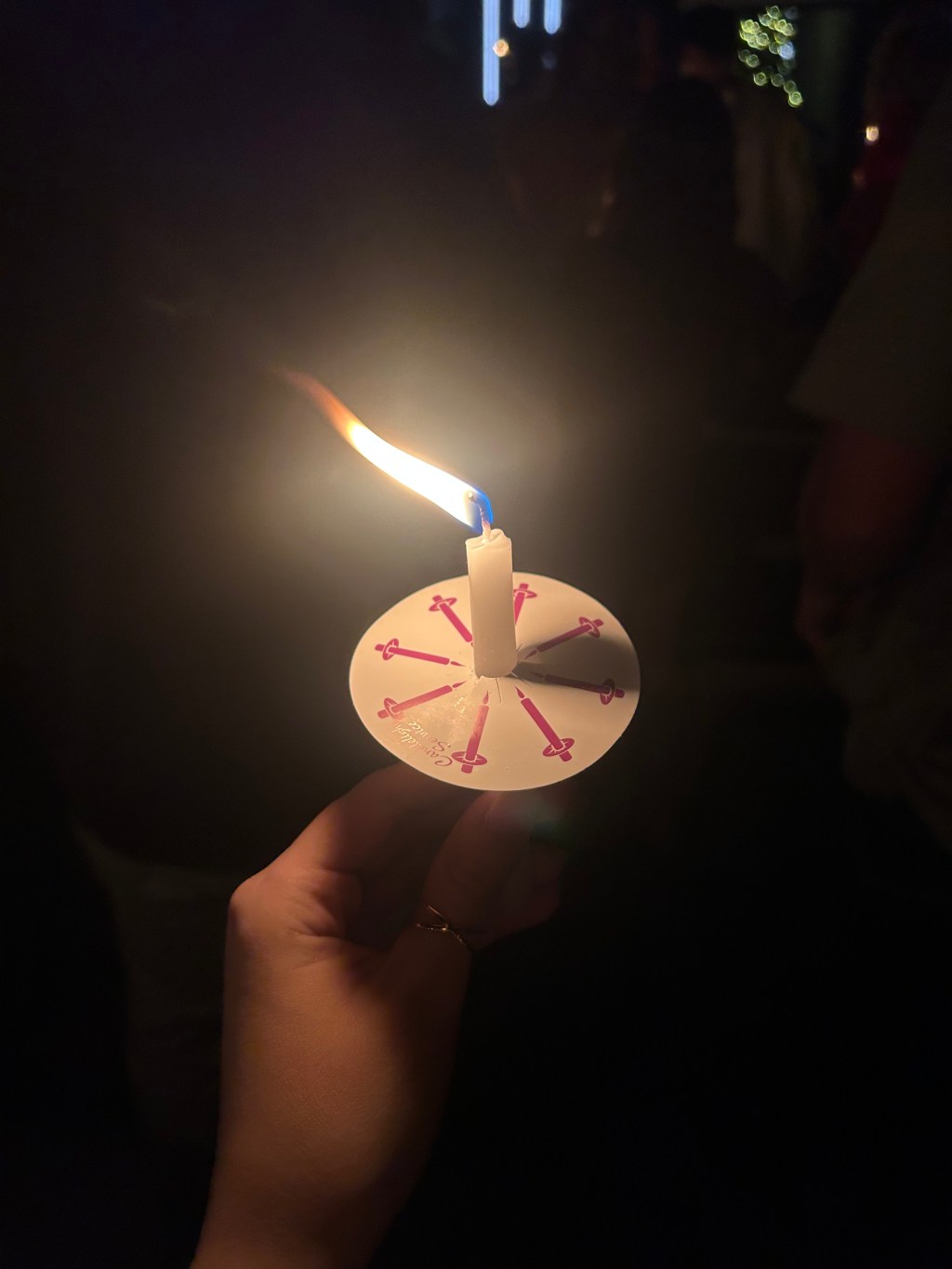
But light and life has come into the world.
We who walk in darkness have a great light —Jesus (Isaiah 9:2). God’s solution to darkness and brokenness was coming near to His broken people. He sent Jesus to suffer in this life with us, experiencing loss, pain, and death. In John 1:5, when talking about this light, it doesn’t say darkness disappears. It doesn’t say, “it’s all better now.” But it does say it – He – won’t be overcome. Jesus is the light. And He shall not be overcome.
This world is broken. I am broken. But light will not be overcome by darkness. I can look to Jesus who lives and know that life was bought for me too. In fact, wholeness was bought for me. James 1:2-4 is a passage we always go through at the beginning of the school year. I never quite understood it the same way I do now. We will meet trials – brokenness, darkness, suffering – of various kinds, but it will result in us being “perfect and complete, lacking in nothing” —AKA whole. Because Jesus conquered death and sin through His death and resurrection, we will not only experience His victorious light but also the wholeness only He can offer us. We will experience life in the midst of trials that ask us to die to our flesh.
So, yeah, my friend was sort of right. I can — we can—rest in the fact that this broken, often dark life is worth the living because Jesus, the Great Light, lives.
Resources
- Broken 25 Playlist
- Psalm 51
- “Because He Lives,” by David Crowder Band
- A Conversation About Anxiety with Blair Linne by With the Perrys
- Take Your Weakness Seriously by Caitlyn Pitts

 Overwhelmed